
Communication and language
Listening, understanding, conversation and the confidence to express ideas, feelings and needs.
Early Years Foundation Stage
The EYFS gives every child a strong foundation for learning, development and wellbeing. At Little Leaps, we bring it to life through meaningful play, caring relationships and experiences shaped around each child.
A shared foundation
The Early Years Foundation Stage is the statutory framework for the learning, development and care of children from birth to five in England. It helps early-years providers support children to learn and develop well, stay healthy and safe, and build foundations for school and later life.
Read the parent guidance on GOV.UKFour guiding principles
These principles work together. Children thrive when they feel secure, are understood as individuals and have inviting spaces and experiences in which to explore.
Seven connected areas of learning
The areas are not separate lessons. They overlap throughout a child’s conversations, movement, imagination, friendships and play.
Listening, understanding, conversation and the confidence to express ideas, feelings and needs.
Secure relationships, emotional wellbeing, independence, confidence and positive interactions with others.
Movement, coordination, fine-motor control, healthy routines and growing confidence in using the body.
A love of stories, songs and rhymes, alongside early mark-making, reading and writing foundations.
Numbers, patterns, shape, space and measure explored naturally through play and everyday problem-solving.
Curiosity about people, communities, nature, places, technology and how the world around us works.
Imagination and self-expression through art, music, movement, materials, storytelling and role-play.
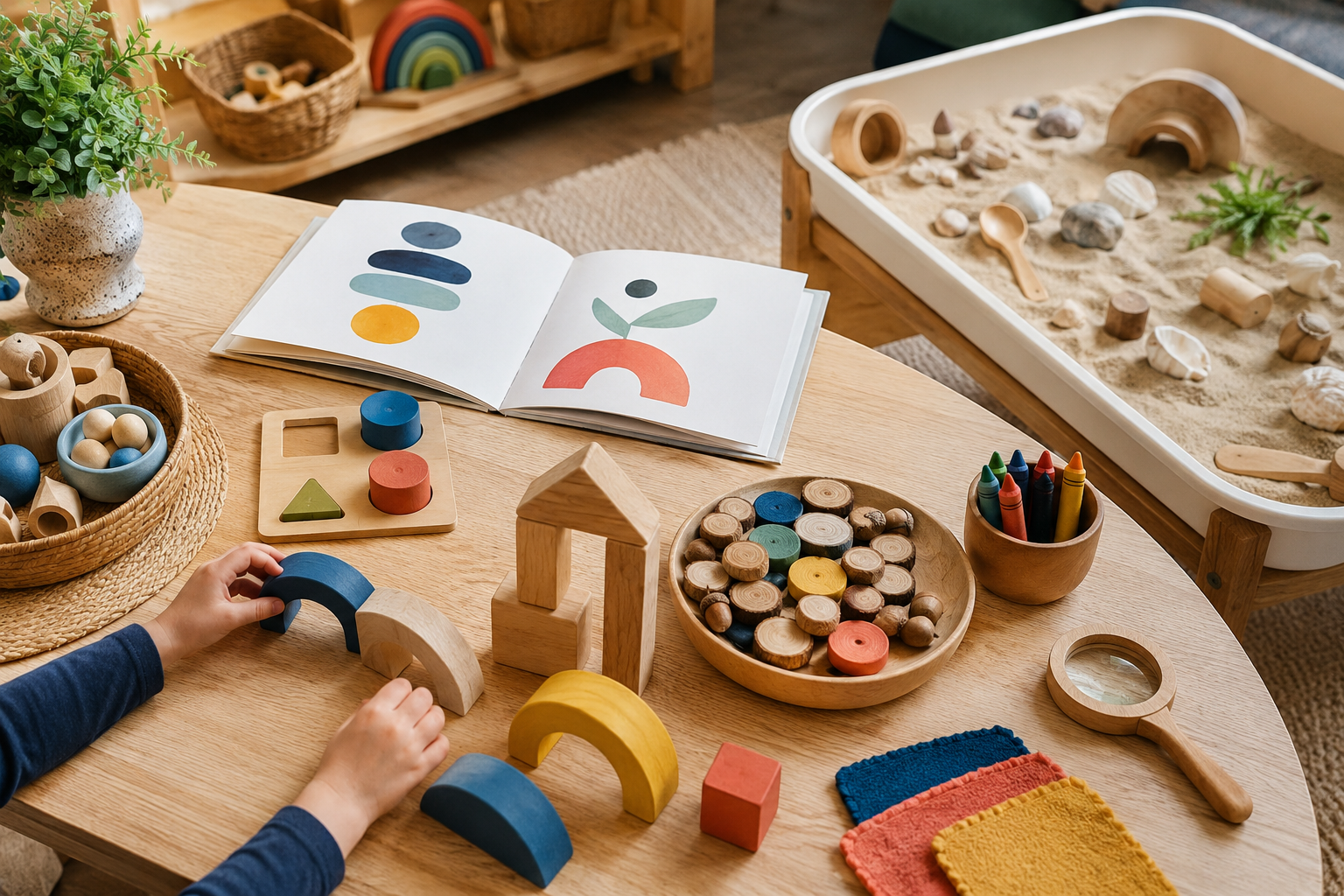 Illustrative image · nursery photography to follow
Learning is connected
A child spending time in the sand may appear to be “just playing”, but that experience can support several areas at once.
This temporary visual gives the page a warm, purposeful focus and can be replaced later with authentic activity photography from Basildon or Grays.
Individual planning
Children do not all develop at the same pace or in the same way. Observation helps us respond to the child in front of us—not simply follow a fixed programme.
We notice what captures a child’s attention, what they can already do and how they prefer to explore.
Practitioners consider interests, development, relationships and any areas where sensitive support may help.
Experiences and environments are shaped around useful next steps rather than a one-size-fits-all timetable.
Children test ideas through play, supported by warm interactions and thoughtful questions.
We review progress with families and use what we learn to guide the next part of the journey.
Tapestry learning journal
Families receive secure access to Tapestry, where our team can share photographs, videos and observations from nursery. Parents and carers can respond, add moments from home and help us understand the child’s wider interests and achievements.
Nursery and home working together gives children a more connected learning journey.
Progress is considered through ongoing observation and professional judgement. Families are kept informed, including around the progress review between ages two and three.
Experiences, communication and environments are adapted around individual development and additional needs. We work alongside families and relevant professionals when more support is helpful.
How the pieces fit together
The EYFS is the national statutory framework. The Little Leaps Early Development Plan is our own clear, child-centred way of organising meaningful learning around five focus areas: Me, Us, Challenge, Imagination and Communication.
Come and explore with us
Visit Little Leaps, meet the team and discover how play, relationships and individual planning support your child at Basildon or Grays.